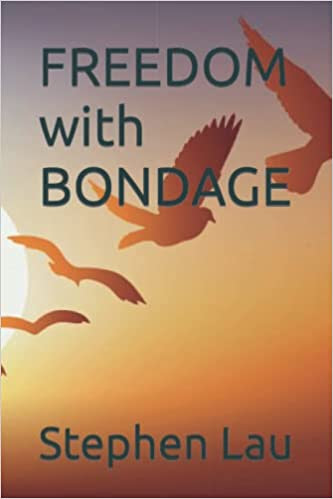
Newly published book: FREEDOM wiyh BONDAGE

Newly published book: <b>FREEDOM wiyh BONDAGE</b>
Newly published book FREEDOM with BONDAGE: You have NO FREEDOM of choices if they are controlled by your flesh to do all the wrong things, and you are held in BONDAGE.

Monday, March 25, 2019

Believing in Yourself Is Mind Power

Believing in yourself is self-efficacy. Believing in yourself is confidence in your own ability, knowing what you have to do to win or simply to get what you want in life.

Diane Sawyer once said: “Whatever you want in life, other people are going to want it too. Believe in yourself enough to accept the idea that you have an equal right to it.” 

Believing in yourself is one of the first steps to success in doing anything that becomes the very substance of your confidence. To have confidence, you must set goals, and achieving your goals helps you build more confidence.

The only stumbling block to believing in yourself is your inability to achieve: some of your goals at some points in your life. This stumbling block may create negativity in the form of victimization. In other words, you may find you are a victim of circumstances; this may also lead to bitterness, despair, or even anger.

One of the reasons why sometimes you don’t have self-efficacy is your past. You could have been haunted by your past failures that generated regrets, bitterness, and disappointments that you have not been able to let go of. Attachment to the past is always a stumbling block to moving ahead.

The Wisdom of Letting Go

The wisdom of letting go shows you how to use the ancient Tao wisdom from China to live in the present moment, and, more importantly, to let go of the past. With both  human wisdom and spiritual wisdom from the Bible, you may start believing in yourself again. With self-efficacy, you can do anything at any stage of your life, and the sky is the limit. 

Stephen Lau
Copyright© by Stephen Lau

Monday, March 18, 2019

A Better Brain and Memory

Do you want to have a better brain and memory even as you age? If yes, then don't let your mind slip!

The human brain has great potential—even for those for who have dementia or memory problems. Your have fully utilized only a fraction of what the human mind is capable of. Therefore, it is never too late to harness the untapped potential of your mind. Don't let your mind slip!

Years ago, Richard Welch, scientist and researcher, developed a reading speed program, and in the process of research and development also discovered an amazing scientific program called Mental Photography. His amazing scientific proven phenomenon can help you harness 98 percent of your untapped brain.

How does Mental Photography work?

Richard Welch’s state-of-the-art system trains your subconscious mind so your memory becomes razor sharp. According to his groundbreaking research, if you have acquired the ability to absorb information speedily, you can then effectively store the information in your long-term memory. No only that, you can store every single word in your long-term memory for life, such that you will never forget it and you can always retrieve it at your will.

But how do you remember it in the first place?

A razor sharp memory requires concentration and focus. Richard Welch uses Albert Einstein’s “Distraction Index” which is a simple but extremely effective exercise that gives you 100 percent laser targeted focus and concentration. He shows step-by-step how you can spend 10 minutes a day just to maintain what you have stored in your long-term memory. You will be able to retrieve the information at any time, and automatically remember things that were once forgotten. Isn’t that remarkable?

Senior moments are common among seniors. But it does not have to be like that. A better brain with a powerful memory and targeted focus will give you an edge in every aspect of life, even as you continue to age. Mental Photography can effectively reduce the amount of sleep you need and make you wake up feeling great with more energy and enthusiasm than ever before. Help your brain remember the things you wish to remember. Do not let your mind slip. Brain health holds the key to longevity health.

For more information on how to build a better brain, go to ZOX Mind Training System.

Stephen Lau
Copyright © by Stephen Lau


>

Saturday, March 16, 2019

Dealing with Anger


Dealing with Anger

Anger or rage is an ineffective and inefficient way to resolve any daily issue or make any problem go away. It is a negative emotion that may lead to depression, if it is not properly addressed. According to scientific studies, strong negative emotions, such as anger, can create destructive mental energy that is health damaging.

So, how do you take care of your negative emotions?

Conventional wisdom is to use distraction to defuse and dissipate the sudden anger or rage.

Thomas Jefferson famously said, “When angry, count 10, before you speak; if very angry, 100.” 

According to Lao Tzu, the ancient sage from China, whose profound wisdom is known as TAO, we should do the following when we are angry:

Take a deep breath, review the situation, and ask yourself one simple question: why are you here in this situation?

Don’t hold your anger in; instead, let it go, by breathing it out. Don’t let it go as pain; instead, let it go as your acceptance. Don’t let your acceptance be viewed as a sign of your own weakness; instead, let it be a statement of your own communication to yourself that getting angry will not resolve the situation.

Remember, anger is always present to serve a purpose to release some deeper issues, problems, and internal conflicts that you may be carrying in your own bag and baggage all these years. It is always better to release anger than to turn it around to destroy yourself. Suppressing anger, on the other hand, is also self-destructive, as the negative energy redirects itself back into your own body. Anger in itself is always a path of destruction no matter what. Resolve anger by developing habits that may release internal conflicts in a constructive manner before it can be released as rage.

Remember, the world always reflects your actions. If you lash out in rage, then the world lashes back at you with that same rage causing pain or grief that still has to get resolved. There is no true “release” of anger, except by resolution.

TAO teaches that peace is the true warrior’s path. The sword while an option is never used with anger, or you may have lost from the start. According to Lao Tzu, “The best fighter is never becoming angry.”

Stephen Lau
Copyright© by Stephen Lau

Saturday, March 2, 2019

Why Letting Go of Attachments in Life


Why Letting Go of Attachments in Life

The dark side of attachments

Desire

Attachments create desire, and desire generates an expectation. To guarantee the fulfillment of the expectation, the mind has to make choices—not so much the choices between doing what is right and what is wrong, as the choices between doing what can and cannot repeat the past success, as well as what can and cannot avoid the future failure. In the process of making these difficult choices, the mind may becomes unduly stressed, leading to anxiety, frustration, and disappointment. Human desire is the root cause of all human woes.

“There is no greater sin than desire,
No greater curse than discontent,
No greater misfortune than wanting something for oneself.
Therefore he who knows that enough is enough
 will always have enough.”
(Lao Tzu, Tao Te Ching, Chapter 46)

Control

Control is the byproduct of attachments, a tool used by the mind to perpetuate the attachments.

“The world is ruled by letting things take their course.
It cannot be ruled by interfering.”
(Lao Tzu, Tao Te Ching, Chapter 48)

Most of us are controlling to a greater or less extent. We, as parents, control our children’s destiny by striving to steer them clear of the wrong path we had previously treaded ourselves.

Our culture tells us that we should be in control of everything around us at all times; controlling, to many, is synonymous with independence.

But controlling is not Tao because it is an unnatural way of running away from everyday problems, instead of embracing them. Controlling is a direct or subtle way of exerting influence over others so that we may have power over the turn of events in our lives. In other words, we delusively think we can make things happen the way we want them to happen in our lives through control and manipulation of others. Of course, it is only a wishful thinking that we can have total control of what happens in our lives.

Indisputably, life is forever changing, whether we like it or not. Just learn to accept the fact that we are sometimes helpless to stop an unwelcome change in our lives. Paradoxically, accepting that unwelcome change may surprisingly bring us peace of mind. Unfortunately, many of us simply choose to avoid it by controlling people who, we think, may either cause or avert that unwelcome change. Control stems from fear and worry, which are projections of the mind into the future, and which are the major factors of stress.

How often we control our children, our parents, our friends, and our co-workers without being aware of our control.

To let go of control requires courage. Mark Twain once said humorously about the cure for insomnia: “Try lying on the edge of the bed, then you might drop off.” Indeed, to go to sleep, you must have the courage to let go of your thoughts before you can fall asleep—just like letting go of the fear when lying on the edge of the bed.

“. . . sometimes it’s necessary to go a long distance out of the way in order to come back a short distance correctly.” Edwar Albee

The bright side of non-attachment

Spontaneity instead of choices

But, with the wisdom of Tao, life does not have to be filled with difficult choices and anxious expectations. Spontaneity is the solution, the secret to the art of living well: letting nature run its natural course.

Empty yourself of everything.
Let your mind rest at peace.
Watch the workings of all of creation,
and contemplate their return.
They grow and flourish and then return to the source.
Returning to the source is stillness,
which is the way of nature.
The way of nature is unchanging.”
(Lao Tzu, Tao Te Ching, Chapter 16)

Spontaneity is similar to what is said in the Bible: “Look at the birds of the air; they do not sow or reap or store away in barns, and yet your heavenly Father feeds them. Are you not much more valuable than they?” (Matthew 26: 26)

Do not over-worry because things do not turn out the way you think they should.

”That which shrinks
Must first expand.
That which fails,
Must first be strong.
That which is cast down
Must first be raised.
Before receiving, there must be giving.
This is called perception of the nature of things.
Soft and weak overcome hard and strong.
(Lao Tzu, Tao Te Ching, Chapter 36)

Stephen Lau
Copyright©by Stephen Lau

Monday, February 25, 2019

The Power of Asking Questions

One of the first things you should teach your children is asking questions: the whys and the why-nots. Life is habit-forming. Once children develop this mental concept of asking questions, they will like to ask questions for the rest of their lives. Asking questions is self-enlightenment, which plays a pivotal role in wisdom. To live well, you need wisdom, not just knowledge and expertise. The latter may give you a successful career, while the former provides you with the key to the art of living well. One of the essential ingredients in wisdom is self-intuition, which involves asking questions to find out not just one's true self or nature, but also the reality of all things. 

According to Lao Tzu, an ancient Chinese sage, knowing yourself is true wisdom.

“Knowing others is intelligence.
Knowing ourselves is true wisdom.
Overcoming others is strength.
Overcoming ourselves is true power.”
(Lao Tzu, Tao Te Ching, Chapter 33)

“Who you are” determines where you are going, what you are going to do, and what kind of a person you are going to become for the rest of your life. Nobody can answer those questions for you, because nobody knows you better than you know yourself. People can be your mentors or role models; they can even provide you with a road map or even a compass. But only you can decide where you are going to turn or make a detour along your life journey, and this is where wisdom comes in. 

Life is all about asking questions, internalizing them in your mind, and finding appropriate answers to those questions asked. Asking questions is introspection, which is a process of self-reflection, without which there is no self-awareness and hence no personal growth and development. A static life is not worth living. Therefore, asking questions is self-empowering wisdom—a life-skill tool to trigger a set of mental answers, leading to actions or reactions based on the choices you make from the answers you have obtained. It is the natural habit of the human mind to try to solve problems by making things happen. According to Samuel Butler“Life is the art of drawing sufficient questions from insufficient premises.” 


Finding out who you really are also determines your physical, emotional, intellectual, and, spiritual needs. They all play a pivotal part in your life because they not only determine your attitude towards the challenges and changes you may encounter, but also define your purpose in your life. 

Socrates once said: “An unexamined life is not worth living.” Examine your life with Tao wisdom. There is much to learn from this ancient wisdom from China.

Tao wisdom is the essence in the art of living well, It is the profound wisdom of Lao Tzu, the author of the immortal classic Tao Te Ching, one of the most translated works in world literature. The book has been popular for thousands of years due to its wisdom, which is simple but controversial, profound and yet intriguing. To fully understand it, you need to get all the essentials of Tao wisdom. Click here for more details.

Stephen Lau 
Copyright© by Stephen Lau

Friday, February 15, 2019

Online Passive Income

If you wish to make some money online, it is doable. Just follow the expertise of some of the most successful online entrepreneurs. What you need is your passion and perseverance to turn your dream into a reality. Of course, you also need the right resources from those experts.

Click here to get the resources to make an online passive income.


Stephen Lau
Copyright© by Stephen Lau

Tuesday, February 12, 2019

The Body-Mind Inter-Connection

The mind plays a pivotal role in the overall wellness of an individual because there is a close inter-connection between the body and the mind.

Mind wellness

Overall wellness starts with the intent of the mind to be well and to stay well.

How well you are living your life right now is based on your past and present life experiences, as well as your projections of those experiences into the future. In other words, your thoughts of those experiences with their respective future projections become the raw materials and resources with which you are going to weave the fabric of your life.

Therefore, to live well, you have to know how to think right, and then act accordingly. That's not easy, and that's why Albert Einstein once said, "Thinking is hard; that's why so few do it."
Learn to empower your mind with knowledge and wisdom and live your life to the best you can.

Body wellness

Body wellness is more than just an absence of illness or ache and pain.

Body wellness means the body is capable of detecting signs and symptoms, as well as deciphering messages, from different organs and tissue of the body, giving warnings of any imminent disorder and disease.

The body is connected with the mind in the form of biochemical reactions in the body and nerve impulses in the brain. This invisible communication is responsible for the alignment or misalignment of the flow of energy between the body and the mind, and hence their overall wellness. The body is a product of both the mind and the soul.
There is much to know and learn about body wellness, just as Hippocrates, the father of medicine, once said: "The life so short, the craft so long to learn."

Learn the craft and get the wisdom!


Stephen Lau
Copyright© by Stephen Lau

Monday, February 11, 2019

No Attachment! No Identity Crisis!

“We usually don't realize the thing that is defining our identity until that thing is taken away.” Tim Hiller

All human attachments are the raw materials with which one both consciously and subconsciously creates one’s identity through a period of confusion and uncertainty that inevitably leads to the identity crisis. Without human attachment, there will be no identity crisis.

Attachment is no more than a safety blanket to overcome fear—fear of change and of the unknown from that change. To cope with that fear, all attachments become distractions.

Attachment is basically your emotional dependence on things and people that define your identity, around which you wrap your so called “happiness” and even your survival. Attachment is holding  on to anything  that you are unwilling to let go of, whether it is something positive or negative.

We are living in a world with many problems that confront us in our everyday life, and many of these are not only unavoidable but also insoluble. To overcome these daily challenges, many of us just turn to attachment as a means of distracting ourselves from facing our problems head on, or adapting and changing ourselves in an ever-changing environment. All of our struggles in life, from anxiety to frustrations, from anger to sadness, from grief to worry—they all stem from the same thing: our attachment to how we want things to be, rather than relaxing into accepting and embracing whatever that might happen after we have put forth our best effort.

Let go of your attachments to avoid any identity crisis in order to live asif everything is a miracle.

Stephen Lau     
Copyright© by Stephen Lau

Sunday, February 10, 2019

Your Wisdom Is Inside You!

Tao wisdom is the profound wisdom of Lao Tzu, the ancient Chinese sage who was the author of the immortal classic Tao Te Ching. Literally, "Tao" means "the Way"; "Te" means "virtuosity"; and "Ching" means "classic." The book was written approximately in 6th century B.C. by Lao Tzu (which literally means "old master"). According to the legend, the ancient sage was forced to put down his profound wisdom into words before he was permitted to leave China for Tibet. Reluctantly, he expressed his wisdom in 81 short chapters with only 5,000 words, because he believed that true wisdom could not be expressed in words. The language he used was extremely simple and concise, but intriguing and paradoxical. That was one of the many reasons why the book has fascinated millions of readers worldwide.  Tao is also known as the Way—the way or direction to understanding true wisdom, whether it is human or spiritual wisdom.

Don't look elsewhere! Tao wisdom is already inside each and every one of us! Tao wisdom is inside you. Jesus said: “Seek and you shall find.” You need not look any further because it is right inside you! Ironically enough, it is not easy to find the Way: we tend to look to others or outside of ourselves in quest of that far-fetched and forever elusive wisdom.

There was the story of a beggar who asked a stranger for money. The stranger said he had no money to give him, and asked the beggar if he would look elsewhere for money, including the box he was sitting on. The beggar said he had been sitting on that box for years but he had never looked inside it. The stranger urged him to look inside the box. Reluctantly, he did. To his amazement, he found the box was filled with gold coins.

Yes, Tao wisdom is inside each and every one of us! But you have to look, just like the beggar did in the story!

Unlike conventional wisdom, which is external, focusing on the acquisition of knowledge, Tao wisdom, on the other hand is internal. According to conventional wisdom, knowledge is empowering; the more knowledgeable you are, the wiser you become. The ancient wisdom of Tao is quite the opposite: the more you know, paradoxically, the less wisdom you may have.

Accordingly, following the teachings of others, looking for role models to imitate, and making extra efforts—all recommended by conventional wisdom—they will not work for the ancient wisdom of Lao Tzu. In Tao wisdom, you just look inside yourself because the internal wisdom is based on intuition of, insight into, and internalizing of your own experiences in life. It is "your" life and "your" own experiences that are uniquely yours. Looking for external sources does not help, and nobody can tell you how you should live your life. Only you have access to your life's blueprint, which is the essence of Tao wisdom in living.

Stephen Lau
Copyright © Stephen Lau

Saturday, February 9, 2019

Tao Wisdom and Contemporary Wisdom

Tao Wisdom and Contemporary Wisdom

There was the story of a beggar who asked a stranger for money. The stranger said he had no money to give him, and asked the beggar if he would look elsewhere for money, including the box he was sitting on. The beggar said he had been sitting on that box for years but he had never looked inside it. The stranger urged him to look inside the box. Reluctantly, he did. To his amazement, he found the box was filled with gold coins.

Yes, wisdom is inside each and every one of us! But you have to look, just like the beggar did in the story! Many people believe that wisdom comes from knowledge. If you don’t go to college, you cannot be wise. Nothing could be further from the truth! Wisdom and knowledge are two separate entities: knowledge provides data and information, while wisdom is the application of the data and information gathered. Wisdom has much to do with the thinking mind—how it processes data and information received and then turn them into life experiences that ultimately become realities that define and create the personality of an individual.

Don't look elsewhere! Tao wisdom is internal wisdom; it is already inside each and every one of us!

Tao wisdom is the profound wisdom of Lao Tzu, the ancient Chinese sage who was the author of the immortal classic Tao Te Ching, which is one of the most widely translated works in world literature, perhaps only second to the Bible. Tao is also known as the Way—the way or direction to understanding true wisdom, whether it is human or spiritual wisdom.

Tao wisdom is inside you. You need not look any further because it is right inside you! Unlike conventional wisdom, which is external, focusing on the acquisition of knowledge, Tao wisdom, on the other hand is internal. According to conventional wisdom, knowledge is empowering; the more knowledgeable you are, the wiser you may become. The ancient wisdom of Tao is quite the opposite: the more you know, paradoxically, the less wisdom you may have. 

As a matter of fact, there was the story of a professor seeking the wisdom of Zen (originated from Tao) from a Zen master who kept on pouring tea into the already filled-to-the-brim teacup of the professor. Later on, the Zen master told the professor that in order to fully understand the wisdom of Zen or the Way, he must, first of all, empty all his preconceived ideas of Zen, that is, he must have an empty mind to be receptive of the wisdom. Hence, to fully understand Tao, one must empty one's mind of any knowledge previously acquired. 

The Book of Life and Living is an explanation of ancient wisdom, contemporary wisdom, and spiritual wisdom illustrated with concrete everyday examples. Create your own recipe for wisdom in living. 

Stephen Lau
Copyright © Stephen Lau

Friday, February 8, 2019

Increase Mind Power

You may have an amazing mind because your brain is made up of about 100 trillion brain cells called neurons, which are responsible for releasing chemicals known as neurotransmitters for effective communication between brain cells. To sharpen your mind, you have to inter-connections between your brain cells since they are all inter-connected. The more connections you have, the greater is your brain power. So, sharpen your mind by increasing your brain cell connections.


Your brain is like a recorder, which records all information on a tape (your neurons). A good memory means your brain knows when to turn on and turn off the recorder. This is crucial. However, the "when" factor is no more than your basic memory skills, without which, you just turn on the recorder all the time. The problem is that you may have just too many tapes: when you want to look for a certain tape, you may have problems finding the right tape and finding it right away. This is how and why people become forgetful, and forgetfulness is the inability to retrieve the desired information when needed.


As you continue to age (e.g. the beginning of senility, whether you like it or not), it takes you longer to recall things, as well as longer time to process new information. Things could even get worse with time: you develop the common tip-of-the-tongue problem in remembering a common word, or a familiar name. The term is "senior moments." Mental deterioration will continue if you live long enough: for example, you don't remember directions, or recall lists, among other daily annoyances and frustrations. Poor memory is associated with old age and a deteriorating brain.
The good news is that you may not have dementia or Alzheimer's if your brain is still healthy. But you do want to avoid, or at least defer, for as long as you possibly can, the occurrence of memory-lapses.


Although you may have an amazing brain, you still need to learn how to harness its power and potential. 


1. Memory has to do with your senses: sight, sound, smell, and taste, and touch. They are your memory skills too, that is, tools for you to remember, store, and process information. Therefore, sharpen your senses to sharpen your mind. Protect and preserve your senses, for example, take care of your vision health, which is critical to having good memory, because sight is an important tool for remembering, storing, and processing information. There is a saying: "A picture is worth a thousand words." You still need good vision to see that picture. 


2. Avoid emotional upheavals, such as depression or stress, which can adversely affect your brain power. Practice daily meditation to calm your nerves, and let your brain relax and rest. Meditation is a powerful tool to optimize your memory skills. Learn how to meditate. All you need is patience and consistency.


3. Avoid pharmaceutical drugs wherever possible, especially over-the-counter ones, such as cold remedies and sleep aids. Drugs are dangerous chemicals that may damage your brain cells. Remember, brain cells, unlike other cells, do not regenerate, although you have trillions of them. Use natural herbs and home-made medicine, which are less toxic and have fewer side effects than the chemicals of pharmaceutical drugs.


4. Good nutrition enhances brain health. The rule of thumb is: What is good for the heart is also good for the brain. Eat a diet low in animal fat to avoid clogging blood vessels in your brain.


5. Try not to do too many things too quickly at the same time. This not only creates time stress but also disorients the mind. Learn to live in the present. Most of us don't; they talk on the cell phones while driving (they are supposed to be driving, not talking about things in the future).


Your brain is one of the most valuable assets in your life. You can keep it functional for as long as you wish. If there is a will, there is a way. Make it your first priority to sharpen your mind and protect your brain health.

Stephen Lau
Copyright© by Stephen Lau


Thursday, February 7, 2019

Mind Power to Change Perceptions

Wellness is feeling good about self with respect to the body, the mind, and the soul. Wellness may be synonymous with happiness.  Wellness comes from the mind – the mind’s perceptions of what the body  is experiencing in the physical world. Wisdom, surprisingly, can change the mind’s perceptions to make one feel better and happier.

Are you happy? What makes you happy? A successful career, satisfying relationships, good health, or material possessions? Which one, or all of those? No matter what, wellness is what makes you feel good about yourself, and what makes your life meaningful. If your life is without a purpose, and you are always drifting from here to there, you won't feel good about yourself or life in general.

Feeling good about oneself requires wisdom -- wisdom to know who you are and what you want in life. Without wisdom, you will not experience lasting well-being. Without wisdom, your living is like like chasing the wind, without any direction.

Wisdom is essential in the art of living well. It involves wisdom of the mind, the body, and the soul. They are all inter-related and inter-dependent on one another. For example, if you have satisfying relationships but your health is rapidly deteriorating, you will not feel well; or if you have a successful career but are emotionally distressed, you will not be in good spirit. Therefore, the overall wellness is contingent on the holistic wellness of the body, the mind, and the soul. To cherish and nourish this holistic wellness, your need wisdom, which holds the key to happiness and well-being of any individual.

Which is wisdom? Where does it come from?

Wellness begins with the mind first, and not the body or the soul. After all, you are what you have become by reason of your thinking. You are a summary of your thoughts, which make you who you are or what you have now become. Your past experiences and your perceptions of those experiences have "preconditioned" how you currently think. In other words, your background, and upbringing predetermine how your mind perceives your present life experiences. Given that your past exposure might not be telling you the whole truth, you, therefore, need wisdom to "empty" your mind and re-define your current mindset. That is to say, you must learn how to rethink your mind. Thinking is never easy and that is why so few people do it, according to Albert Einstein.

You are living in a physical world, and your life experiences are perceived by your body through the five senses (seeing, hearing, smelling, tasting, touching). But these sensations may be positively or negatively interpreted by the mind, which stores past experiences of those sensations of body in both the conscious mind and the subconscious mind. The former voluntarily accepts or rejects those sensations, while the latter involuntarily includes whatever the subconscious mind is exposed to. True wisdom is the capability of the mind to know what is real and what is unreal. 

Tao wisdom is the ancient wisdom from China that shows you how to have an empty mind first to rethink your mind in order to separate the truths from the half-truths t Perceptionso Changeor myths.

Tao wisdom is the essence in the art of living well, It is the profound wisdom of the ancient Chinese sage, Lao Tzu, the author of the immortal classic Tao Te Ching, one of the most translated works in world literature. The book has been popular for thousands of years due to its wisdom, which is simple but controversial, profound and yet intriguing. To fully understand it, you need to get all the essentials of Tao wisdom. Click here for more details.


With Tao wisdom, you may live a much better life, without depressive episodes now and then.

Stephen Lau     
Copyright© by Stephen Lau